
There is a certain kind of person everyone assumes will always manage. Not because life is easier for them or because problems somehow pass them by, but because they have the unfortunate habit of finding solutions even when they no longer have the energy to look for them. I belonged to that category, and if there had been an award for turning disastrous days into apparently normal ones, I would probably have had an entire shelf full of trophies.
That morning, for example, I had woken up with a headache, three missed calls, and a four-year-old who had decided he no longer wanted to go to kindergarten. His reason was perfectly serious: he didn’t like the top I had chosen for him.
“But you liked it yesterday,” I said, trying to remain calm.
“Yesterday, yes. Today, no.”
I looked at him, then at the top, searching for a reasonable explanation for his sudden change of opinion. Then I remembered I was talking to a four-year-old, for whom yesterday was already a distant past with absolutely no authority over the present.
“So what do you want to wear?”
He pointed to a thin T-shirt with a cartoon character on the front.
“That one.”
“It’s cold outside.”
“I’m not cold.”
“You haven’t even been outside yet.”
He looked at me with the seriousness of a lawyer preparing a closing argument.
“But I know.”
I sighed and started looking for a warmer top he would agree to wear over his favorite T-shirt. After several more minutes of negotiations, we reached a compromise. He was satisfied because he got to keep his T-shirt, and I was satisfied because he wouldn’t arrive at kindergarten dressed for a summer afternoon.
Sometimes motherhood resembled international diplomacy far more than the peaceful scenes shown in advertisements for children’s products.
—
At work, the day began before I had the chance to finish my coffee. A colleague needed help, an activity had to be reorganized, and a last-minute problem threatened to disrupt the entire team’s schedule. I left my cup on the desk, listened to the explanations, and began distributing tasks, hoping to resolve everything before the situation became even more complicated.
I liked my job, even when it exhausted me. I enjoyed coordinating people, finding solutions, and seeing how a day that had started badly could be saved through a little organization. At work, I didn’t have time to analyze every emotion, and most problems were concrete. If something wasn’t working, I looked for the cause. If a plan failed, I changed it. If someone didn’t understand an instruction, I tried explaining it differently.
I wished relationships between people worked according to the same rules.
In my personal life, I could explain what hurt me ten different ways and still not be understood. I could offer solutions, make compromises, and try to preserve a connection without any guarantee that the same effort was being made on the other side.
It was frustrating to discover that the thing I was best at—fixing what wasn’t working—was almost useless when feelings were involved.
“Did you manage to sort it out?” a colleague asked, stopping beside my desk.
“Yes, I reorganized a few things. It should be fine now.”
“I knew you’d figure it out.”
I smiled and turned back to my computer, but those words stayed with me.
I knew you’d figure it out.
I’d heard them so many times that they had begun to feel like an obligation. People trusted me, which was a wonderful thing, but they rarely wondered what happened when I no longer had the strength to manage.
Perhaps I’d never given them the chance to find out.
—
During my lunch break, I found a quieter place and took my phone out of my pocket. I had no urgent reason to check it, but the gesture had become part of my routine, as natural as opening a door or searching for my keys.
I went through my notifications and opened social media. There were photographs, a joke, a post about the weather, and a video I watched without understanding why it had become so popular. I kept scrolling until I realized I wasn’t looking for any of those things.
I was looking for a sign.
Not necessarily a long message or a declaration. Sometimes a simple question would have been enough, something to show me that I hadn’t completely disappeared from someone’s thoughts. Then I would become angry with myself for attaching so much importance to such small gestures.
I remembered our conversations during the summer, when there had been no need to invent reasons to talk. Messages arrived naturally, sometimes at impossible hours, and the differences between our languages had become a source of amusement rather than an obstacle. I remembered laughing over terrible translations and the way certain expressions, once explained, acquired a meaning that belonged only to us.
I couldn’t identify the exact moment when things had begun to change. There hadn’t been a dramatic argument, a clear goodbye, or an explanation that made sense of everything. Instead, there had been a gradual drifting apart, so slow that at first I had tried to convince myself I was imagining it.
Perhaps it was a difficult period. Perhaps there were problems I knew nothing about. Perhaps the distance had become too much.
I had found so many possible explanations that I had almost forgotten to ask myself how the situation made me feel.
I locked my phone and put it away. I still had half a working day ahead of me, and my responsibilities weren’t going to disappear simply because I felt lost.
—
I had a therapy appointment that afternoon.
I’d considered postponing it several times, not because I didn’t want to go, but because I was tired and imagined that spending an hour talking about my feelings would exhaust me even further. Still, I already knew that avoiding painful things didn’t make them disappear. Usually, it only gave them more room inside my head.
I arrived a few minutes early and sat in the waiting room. I glanced at my phone, then put it in my bag, determined not to check it again until the session was over.
When I entered the office, my therapist greeted me with the same calmness that sometimes, inexplicably, irritated me. Not because anything was wrong, but because I arrived carrying a thousand thoughts, while the quiet room seemed almost provocative.
“How has your week been?” my therapist asked once I was seated.
I shrugged.
“Normal. Lots of work, my son, things around the house. Nothing special.”
“And how have you been feeling?”
I opened my mouth to answer, then stopped.
It was a simple question, but I didn’t know where to begin. I could describe everything I’d done each day, every problem I’d solved, and every task I’d crossed off my lists. But when it came to explaining how I’d actually felt, words became much harder to find.
“Tired,” I finally said.
“Physically or emotionally?”
I gave a half-hearted smile.
“Is there an option where I can choose both?”
My therapist smiled too, then waited for me to continue.
I talked about my hectic mornings, my responsibilities at work, and how I tried to be present for my son even on days when I felt I had nothing left to give. I explained that I was managing, that life was moving forward, and that, generally speaking, I had no reason to complain.
“I notice you say you manage quite often,” my therapist observed.
“Because I do.”
“And what happens on the days when you don’t?”
I looked up.
“I can’t really afford days like that.”
The answer came so quickly that it surprised even me.
My therapist didn’t rush to respond. The silence settled between us, and I began to feel uncomfortable. I didn’t like silence when someone was waiting for an answer. I always felt responsible for filling it.
“I mean…” I continued, “if I don’t do certain things, who will? My son needs me, I have responsibilities at work, and there’s always something that needs doing at home. I can’t just stop.”
“We’re not talking about abandoning your responsibilities. We’re talking about recognizing that you have limits too.”
I looked down at my hands.
I knew that was true, but there was sometimes an enormous distance between understanding something and actually putting it into practice.
—
When the conversation turned to that summer, I immediately felt my voice change. I’d tried to tell the story calmly and explain everything in a logical order, but memories never respected the order in which I wanted to arrange them.
“What hurts the most right now?” my therapist asked.
I thought for a moment.
“I think it’s not knowing.”
“Not knowing what?”
“What was real and what wasn’t. Whether things changed or whether I misunderstood everything from the beginning. Whether I should have done something differently. Whether there’s still something there, or whether I’m the only one still thinking about it.”
I paused, trying to steady myself.
“And it makes me angry that I can’t fix anything. At work, when there’s a problem, I find a solution. Here, I don’t even know what the problem is.”
“Perhaps because it doesn’t depend entirely on you.”
I looked up.
It was such an obvious statement that I almost wanted to laugh. And yet, for months I’d behaved as though finding the right words or showing enough patience could somehow change the direction of the story all by myself.
“I know that,” I said quietly. “But it’s hard to accept.”
“What do you think would happen if you stopped constantly searching for an explanation?”
For a moment, I imagined a day when I no longer analyzed every conversation or wondered what every silence meant.
“I’d be afraid,” I admitted.
“Why?”
“Because I’d feel like I was giving up.”
The words hung between us, and I realized I’d just said something important.
I wasn’t only afraid of losing someone. I was also afraid that, if I stopped trying, I would be the one allowing the story to end.
My therapist looked at me thoughtfully.
“Taking care of yourself doesn’t necessarily mean giving up on someone.”
I didn’t answer immediately. I wanted to believe it, but I still didn’t know how to reconcile those two things.
—
When I left the office, the cold air made me pull my coat more tightly around myself. I walked slowly to my car and sat behind the wheel without starting the engine. I needed a few minutes in which I didn’t have to do anything.
I felt exhausted, but it was a different kind of exhaustion from the one I’d brought into therapy. It was the feeling that follows a long conversation you’ve postponed for too long, even though you knew it needed to happen.
I took my phone out of my bag and looked at the screen. The message part of me was still waiting for hadn’t arrived. I felt the familiar disappointment, but for the first time that day, I didn’t try to explain it away or fight it.
I simply allowed it to exist.
Then I started the engine and drove to pick up my son.
—
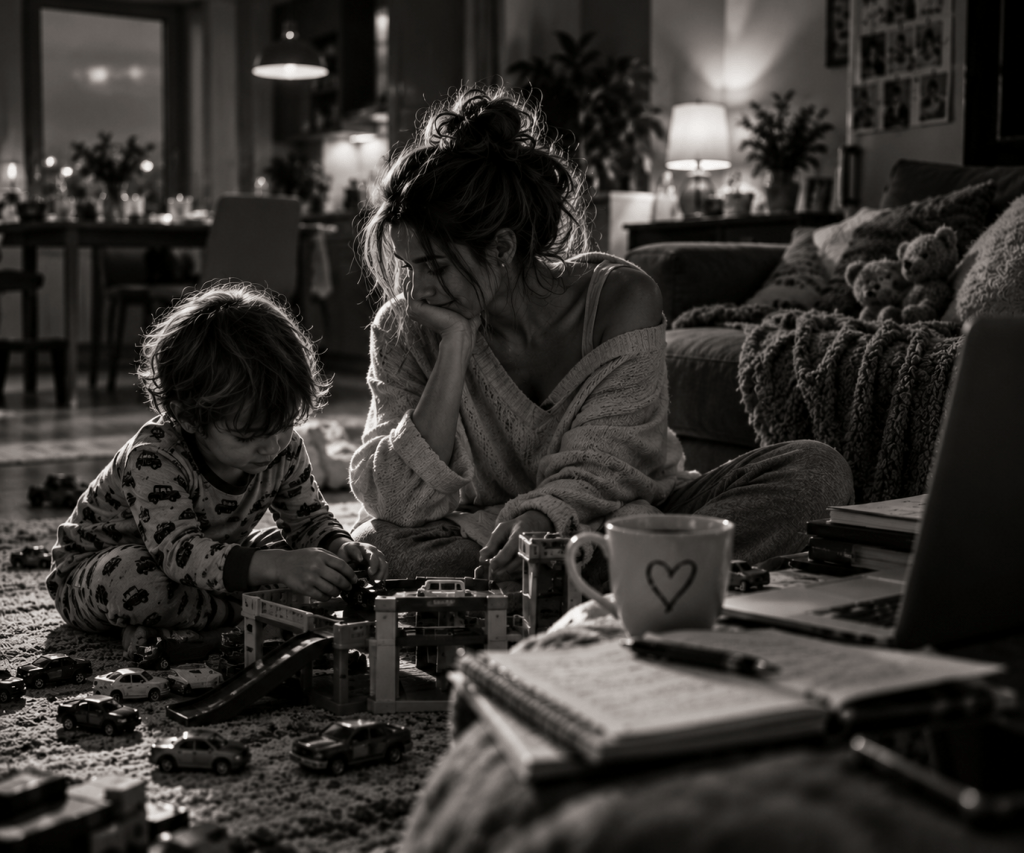
That evening, my little boy insisted that we build a garage for all his toy cars. We spread the pieces across the carpet and started putting them together, although I was fairly certain construction wasn’t among my talents. He, on the other hand, had a very clear vision for the project and didn’t hesitate to correct me whenever I placed something in the wrong position.
“Not like that, Mommy! That’s the door!”
“My apologies, Mr. Architect.”
“I’m not an architect. I’m a driver!”
“Of course. My mistake.”
I laughed, and he smiled proudly, without understanding why I found the exchange so funny. We continued building until the garage became too large for the space we’d chosen, leaving half the cars parked across the living room.
At one point, he came over and climbed into my lap, holding a toy car in each hand.
“Mommy, are you sad?”
The question caught me off guard.
“Why do you ask?”
He shrugged.
“Just because.”
I looked at him for a few seconds. I didn’t know how much a four-year-old could notice about my changing moods, but sometimes I had the feeling he understood far more than I realized.
“I’m a little tired, sweetheart,” I answered. “But I’m okay now.”
He considered this for a moment, then held out one of his cars.
“Here. You can have this one.”
I took it and smiled.
“Thank you. It’s lovely.”
“It’s fast.”
“Then I’m sure it’ll help.”
He climbed off my lap and returned to his game, convinced he’d given me exactly what I needed.
Perhaps, in a way, he had.
—
After putting him to bed, I went into the kitchen and began clearing the dishes. It was almost ten, and I felt as though the entire day had passed without leaving me a moment to breathe. On the table lay the notebook where I wrote down important tasks. I opened it and looked at the list for the following day.
There were problems to resolve at work, groceries to buy, and things to prepare for kindergarten. Further down, in hurried handwriting, I’d reminded myself to call about an appointment and check a document.
I sat down and stared at the page.
Everything on that list mattered, but none of it had anything to do with me, with what I wanted, or with what made me happy. It was nothing but responsibilities, obligations, and small problems waiting to be solved.
I picked up my pen and, for the first time in a long while, added something different.
Do something just for myself.
I looked at the sentence and smiled. It was so vague that it almost seemed pointless. I didn’t know what I would do, when I would do it, or how much time I could allow myself, but at least I wanted to begin thinking about it.
My phone vibrated on the table.
My heart jumped before I even saw the screen.
It was a message from a friend asking whether I wanted to go out for coffee over the weekend.
I held the phone for a few seconds. My first instinct was to say I wasn’t sure, that I’d probably be busy, that I was tired, and that we’d arrange something another time. That was how I usually responded when someone suggested something that had nothing to do with my responsibilities.
Then I looked at the notebook again.
Do something just for myself.
I opened the conversation and typed:
“Yes, let’s go. I really need it.”
The reply came almost immediately, along with a joke about how difficult it had become to get me out of the house.
I laughed alone in the kitchen.
—
Before falling asleep, I thought about the conversation in the therapist’s office and the question I’d been asked: what would happen if I stopped constantly searching for explanations?
I still didn’t have an answer. I would probably check my phone again the next day, think about the summer, and feel the same longing I’d been trying to understand for so long. I didn’t expect to change overnight, and I didn’t want to make promises to myself that I wasn’t sure I could keep.
But I had begun to notice something.
Whenever someone needed me, I found a way to be there. For my son, my colleagues, my family, or my friends, I somehow made room in my schedule, even when the day already seemed completely full.
For myself, however, there was almost always only whatever time happened to be left at the end.
And most days, there was nothing left.
I turned off the light and lay in bed, listening to the quiet of the house. From the next room came the peaceful breathing of my little boy, while my phone remained facedown on the bedside table.
I hadn’t suddenly become someone who knew how to set boundaries. I hadn’t stopped loving, and my questions hadn’t disappeared. I was still the same woman who would wake up early and try to keep everything in order.
But for the first time, I was beginning to wonder who took care of me when I was too busy taking care of everyone else.
And perhaps that question finally deserved an answer.
End of Chapter II.


Leave a Reply