
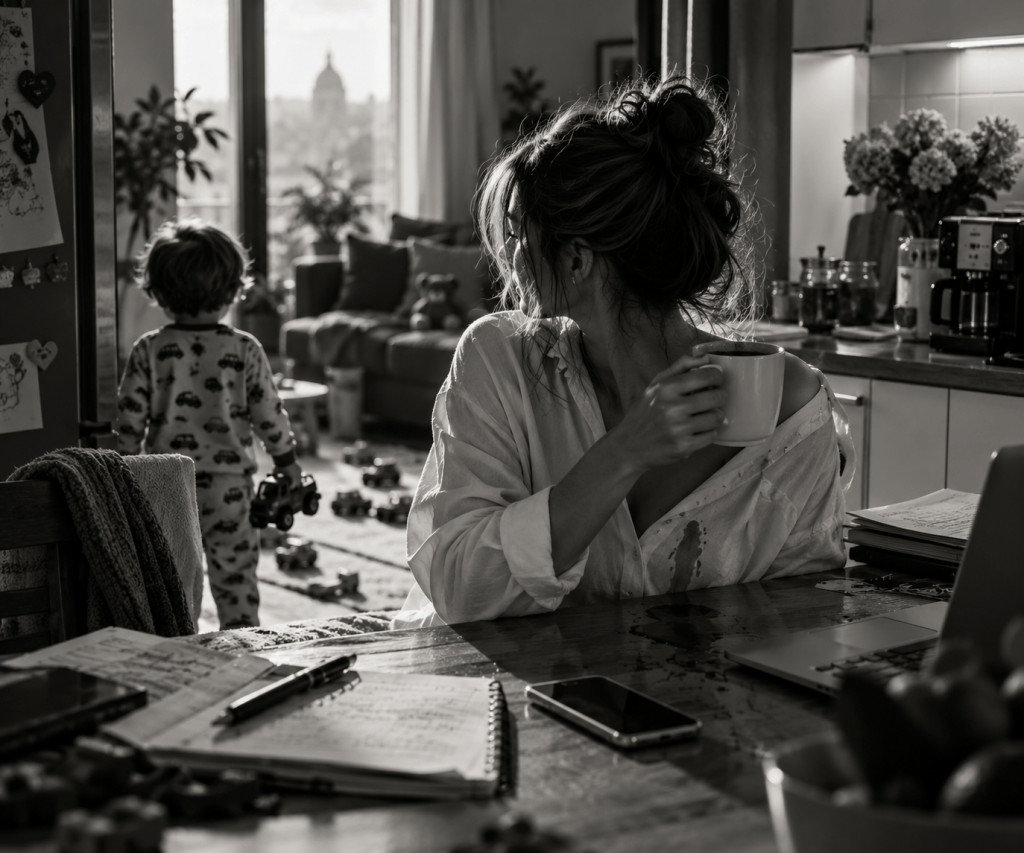
The morning I began losing patience with the entire human race, I spilled coffee all over the white blouse I had just put on. For a few seconds, I stood motionless in the middle of the kitchen, watching the brown stain slowly spread across the fabric, as though the universe had decided my day needed a particularly memorable beginning. It was 7:12 a.m., we had less than ten minutes before we needed to leave, and my four-year-old son was still in his pajamas, absolutely convinced that the most important crisis of the morning was the disappearance of a little red toy car.
“Perfect. Absolutely perfect!” I muttered, setting my cup on the table.
His voice immediately came from the living room.
“Mommy, did you find my car?”
“Not yet, sweetheart. But at this rate, I think we’ll solve all the mysteries of the universe before we find it.”
He either didn’t hear me or, more likely, didn’t care. At four years old, the world has its own priorities, and a missing toy car can be a far greater tragedy than being late for work. I hurriedly changed my blouse, recovered a shoe from underneath the couch, and eventually discovered the missing car in the refrigerator, beside a container of yogurt. I didn’t ask for an explanation. Motherhood had taught me that some situations simply exist beyond the reach of logic.
By the time we finally left the house, I was already exhausted, although the day had barely begun. I settled my son into his car seat, checked his seat belt, and started driving toward kindergarten, trying to ignore the fact that my hair looked nothing like I had imagined it would the night before.
In the back seat, my little boy was singing with enough enthusiasm to wake an entire neighborhood. Every now and then, he asked me to look at a passing truck or explained why certain cars were faster than others. I listened and answered his questions, but somewhere beneath those ordinary moments, my thoughts kept drifting back to a summer that had ended long ago.
I hadn’t gone on that vacation intending to fall in love. All I had wanted was a few days away from responsibilities, from the routines that repeated themselves almost identically, and from the feeling that my life had become an endless succession of things that needed fixing. I wasn’t looking for promises, and I certainly hadn’t expected an accidental encounter to change so much inside me.
And yet, it had happened.
I remembered a bench, two coffees, a little chocolate, and conversations in which words weren’t always enough. I remembered our clumsy attempts to understand each other, the laughter caused by terrible translations, and the unusual silence that sometimes settled between us. There had been looks that said more than an entire conversation could have expressed, and gestures so small that they probably wouldn’t have meant much to anyone else.
But they had meant something to me.
Especially one evening spent watching the sunset, when time seemed to slow down and the future no longer looked like a list of obligations, but like a beautiful possibility.
“Mommy, look at that huge truck!”
My son’s voice brought me abruptly back to the present. I looked toward the road, smiled, and agreed with him. To him, the morning was simple and happy: there was an impressive truck, a day at kindergarten ahead, and the certainty that I would return to pick him up that afternoon. He had no reason to wonder why adults sometimes stared into the distance or why a song could suddenly make them fall silent.
For a moment, I wished I could see the world with that same simplicity.
—
At work, things were different. There, I knew what needed to be done, and no matter how complicated a situation became, I could usually find a way to resolve it. I organized tasks, checked documents, answered questions, and tried to maintain order even when everyone around me seemed determined to turn a minor problem into a catastrophe.
I liked being capable. I liked knowing I could rely on myself and that there was at least one place in my life where effort eventually led to a tangible result.
“Are you okay?” a colleague asked, noticing that I had been staring at the same document for several minutes.
I looked up and smiled almost automatically.
“Yeah, I’m just a little tired.”
It was the answer I’d been giving everyone lately. Tiredness was easy to explain and didn’t require anyone to ask uncomfortable questions. If I said I hadn’t slept well, someone would recommend coffee or a restful weekend. If I admitted that sometimes my heart hurt so badly I could barely concentrate, the conversation would probably become much more complicated.
So I preferred to be tired.
It was easier for everyone.
At lunchtime, I checked my phone. There were a few notifications, an unimportant message, and an email I had absolutely no desire to open. My eyes moved across the screen, instinctively searching for a particular name, before I locked the phone and placed it back on my desk.
There was nothing.
I was angry with myself for feeling disappointed, especially because I knew how little a simple message would actually change. It wouldn’t explain everything that had been left unclear, repair the distance that had grown between us, or erase the evenings I’d spent trying to understand how closeness could turn into silence so quickly.
Still, part of me continued waiting.
Sometimes I wondered whether I missed what we had experienced or what I had believed we were going to experience. It was a distinction I still couldn’t fully understand. The memories were real, the emotions had been real, and the plans had carried, at least for me, the weight of things that were actually going to happen.
Perhaps that was why accepting the present felt so difficult. I hadn’t only lost a connection; I had also lost the image of a future I had begun to believe in.
—
After work, I went to pick up my little boy from kindergarten. He spotted me before I reached the gate and ran toward me with his arms wide open, calling my name so loudly that several people turned around and smiled.
I caught him in my arms, and he wrapped himself around my neck with all the strength a four-year-old could possibly possess.
“Mommy, you won’t believe what I did today!”
And he began telling me everything.
I heard about another child, a toy that had caused a serious disagreement, and something that had happened during lunch, although the order of events remained impossible to establish. I listened carefully, asking questions and trying to reconstruct the story from the fragments he offered.
Eventually, I understood that he’d had a good day.
That was all that mattered.
Back home, the evening passed quickly. I prepared dinner, picked up the toys scattered across the living room, put some clothes in the washing machine, and replied to a message from my mother, who wanted to know whether I had eaten. I told her I had, although the truth was that I’d tasted bits of my son’s dinner and had another coffee.
My mother lived in her own home and had her own responsibilities, but she possessed an extraordinary talent for sensing, even from a distance, when I wasn’t taking proper care of myself.
After his bath, my little boy insisted that we read another story. I agreed, even though I was so tired that some of the words were beginning to blur together on the page. He curled up beside me and listened until his eyelids grew heavy and his questions became fewer and farther between.
When he finally fell asleep, I adjusted his blanket and stayed for a few moments, watching him.
At times like that, my life felt complete. Not perfect or free from problems, but filled with something so important that I didn’t need words to understand it.
Then I would leave his room, and the quiet of the house would sometimes bring back everything I had managed to keep at a distance throughout the day.
—
I sat on the couch with my phone in my hand. There was no particular reason to check it, but my fingers already knew the way to the conversation I was trying not to open anymore.
I looked through a few old messages and felt that familiar tightness in my chest.
I couldn’t understand how so many beautiful words could exist in a past that no longer resembled the present. I remembered the promises, the excitement, and the feeling that distance was merely a practical problem, something we would overcome with patience and a little courage. Now, distance seemed to mean far more than miles. It was made of increasingly rare conversations, unanswered questions, and important things I no longer knew how to say.
I closed my phone and leaned my head against the back of the couch.
Tears filled my eyes, and this time I didn’t try to hide them. There was nobody there who needed an explanation for why I was crying, and I no longer had the energy to pretend that everything was fine.
I missed what we had.
Such a simple statement, and yet so painfully complicated.
I missed the way things had been, the way I had felt, and the version of myself that had dared, for a few weeks, to believe in a new beginning without fear.
But beneath the longing was an exhaustion I could no longer ignore. I was tired of trying to understand, all by myself, things that should have been discussed together. Tired of searching for explanations behind every silence and turning the smallest gesture into a possible sign that nothing had truly ended.
And yet, I wasn’t ready to let go of hope completely.
Perhaps that was the hardest thing to admit.
—
Before going to bed, I stepped into my son’s room once more. He was sleeping peacefully, stretched sideways across the bed, one hand tucked beneath his cheek and his blanket almost falling onto the floor. I covered him carefully, and he shifted slightly before murmuring:
“Mommy…”
“I’m here, sweetheart,” I whispered.
He didn’t wake up, but a faint smile appeared on his face.
I stayed beside him, thinking about how strange it was that the heart could hold such different emotions at the same time. I could be grateful for my son, for our home, and for everything I had managed to build without that meaning I wasn’t allowed to grieve something I had lost. I could laugh in the morning and cry at night, be strong at work and vulnerable in the privacy of my own home, without any of those versions of myself being false.
Perhaps I didn’t need to judge myself so harshly for what I felt.
I returned to my bedroom and placed my phone facedown. The next morning, I would wake up early, prepare breakfast, probably search for another missing toy, and go to work again. I would solve problems, answer questions, and try to find a few moments of peace among all my responsibilities.
I didn’t know how much longer it would hurt. I didn’t know whether I would ever receive the answers I was waiting for, or whether that story had truly come to an end.
All I knew was that morning would arrive regardless, and my little boy would call for me from the next room, asking me to find his favorite toy car.
And I would get up.
Not because I had forgotten, not because I was healed, and not because I had suddenly become stronger, but because my life continued to exist beyond everything that was hurting me.
There was nothing extraordinary about it.
Just an ordinary morning, a four-year-old child, spilled coffee, and a heart trying, in its own way, to learn how to keep beating.
End of Chapter I.


Leave a Reply